

Access management privileged (PAM)
PAM oversees the processes and technologies needed to protect privileged accounts, allowing supervision and control of the activities of privileged users as soon as they log on to the system.
Allows real-time tracking the activities of privileged users.
PAM security limits user access to protecting data .
Reduces risk of unauthorized access and threats of data breaches.
Supports integration with local and cloud applications
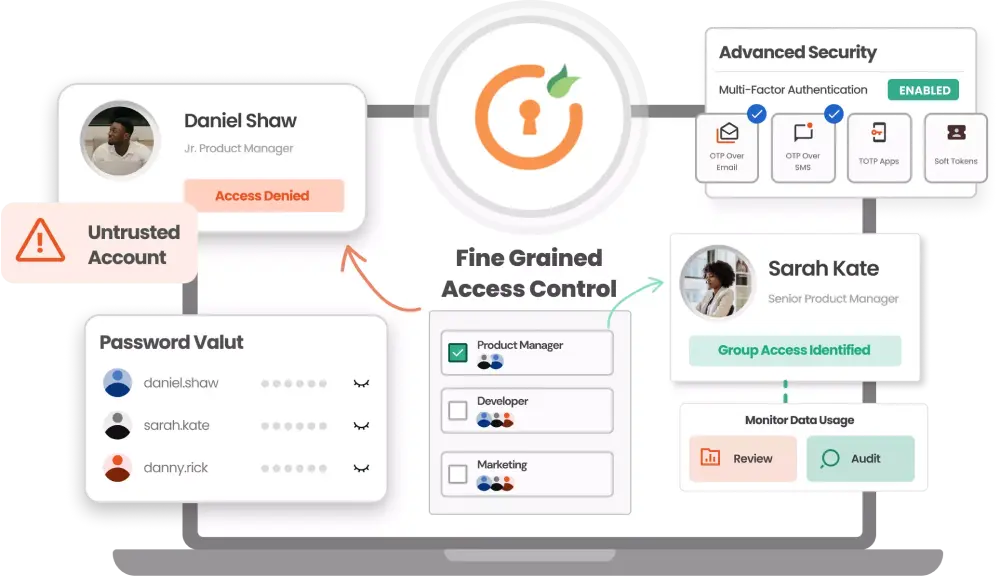

What is Privileged Access Management (PAM)?
Privileged Access Management or PAM is an identity security solution that focuses on ensuring that only authorized individuals can perform critical tasks within an organization's IT environment. These tasks include installing software, making changes to system settings or accessing confidential data.
The PAM framework is an identity security solution that focuses on managing and protecting identities that have elevated permissions beyond those of regular users. This encompasses a strategic mix of people, technology and processes. PAM restricts access to key accounts and monitors them continuously. The Privilege Access Management (PAM) domain falls within the broader scope of Identity and Access Management (IAM) and identity security. Merging IAM with specific PAM controls ensures a robust defense against evolving threats targeting the identity infrastructure, protecting the company's most critical assets.
Privileged access

What is privileged access?
Privileged access refers to the special permissions granted to certain user accounts within an organization, allowing them to perform administrative-level tasks and access confidential information beyond the reach of ordinary user accounts.
- Supervised by a manager with privileged access.
- Essential for the maintenance and safe operation of IT systems.
- It enables tasks such as system configuration, network management and access to confidential data.
Privileged access control is crucial, as the nature of privileged access means that it must be carefully managed and monitored to prevent security breaches, as it provides extensive control over the organization's technological infrastructure.
Privileged user
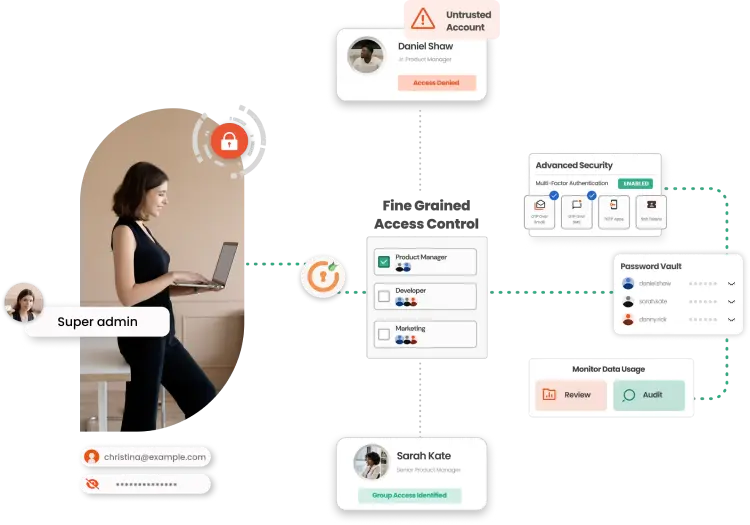
What is a privileged user?
A privileged user is someone with special access to do important tasks that ordinary users cannot. This can include IT staff, senior executives or others who need extra access.
- Being a privileged user is very important for security.
- The organization needs to be careful about who gets this access and how it is managed to avoid risks such as internal threats or cyber attacks.
Managing privileged user access is important for keeping things secure. That's where Privileged Access Management (PAM) comes in, helping to prevent unauthorized access and cyber threats.
How does PAM work?

The main features of our PAM solution include:
- Identification of privileged accounts : identification of accounts with high access to ensure targeted application of security measures.
- Password management for service accounts automatic password renewal for greater security with each access.
- Multi-factor authentication (MFA) This applies an additional layer of security for system administrators to prevent unauthorized access.
- Detailed logs of privileged sessions comprehensive record-keeping for auditing and monitoring, enabling rapid detection and response to possible security problems.
Our PAM solution automates your organization's security policies, providing a powerful platform for managing and monitoring privileged accounts. It is designed to simplify the governance of access rights, significantly reducing the risk of data breaches and ensuring compliance with regulations. Protect your critical assets effectively with our cutting-edge PAM solution
How does privileged access management work?
Privileged Access Management ( PAM ) is an essential security approach designed to protect your organization's sensitive data and systems. It grants and manages top-level access for certain users, allowing them to perform important tasks across multiple accounts, systems, servers and databases.
PAM ensures that only authorized personnel can access critical resources, reducing the risk of security breaches caused by compromised privileged accounts.
- Continuous monitoring and regular review of user privileges.
- PAM helps maintain strong security for your organization and adapts quickly to changes in user responsibilities.
Privileged Accounts
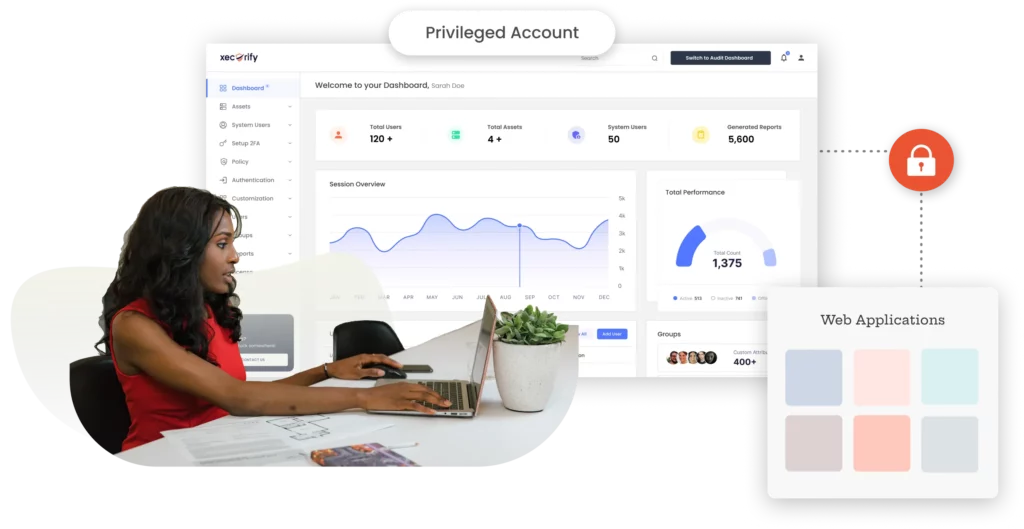
What are privileged accounts?
Privileged accounts are high-level corporate accounts that grant comprehensive access to critical IT tasks, distinguished from regular user accounts by their advanced permissions. These accounts cover human, application and service accounts, each tailored to specific functions within an organization's infrastructure. Designed for IT professionals and administrators, privileged accounts allow full control over system, network and data management.
- Offer unrestricted access to files, directories and resources
- Ability to carry out significant network changes, such as software installation, system modifications and user management
Due to their high level of access, privileged accounts pose a greater security risk, requiring robust management and security measures to prevent possible breaches.
- Our solution ensures that your privileged accounts are managed securely
- Provides essential controls and monitoring to protect your critical assets
Types
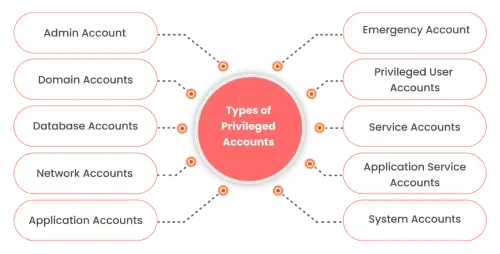
- Emergency accounts (Break-Glass) Reserved for crises, these accounts provide immediate access when the regular administrative channels are not available.
- Privileged user accounts The new "user interface": designed for users who need elevated access for specific tasks, combining user flexibility with control.
- Service accounts These accounts support the operation of applications and services and run under specific credentials to perform tasks automatically.
- Application service accounts Service accounts: similar to service accounts, but specifically for applications, enabling automated processes and tasks within applications.
- System accounts : low-level accounts used by the operating system to manage core system processes, essential for system stability and security
Types of privileged accounts
Understanding the variety of privileged accounts is essential for protecting your organization's digital assets. While standard user accounts are sufficient for day-to-day tasks, certain roles within IT require elevated access for specialized functions.
Our platform separates these privileged accounts into distinct categories, each adapted to specific administrative and operational needs.
- Administrator account (root/administrator accounts) These are the keys to their kingdom, guaranteeing complete control over systems and servers. They are normally used by IT administrators for high-level tasks.
- Domain accounts Domain accounts: essential for managing access to network resources, domain accounts provide users with specific permissions for network domains.
- Database accounts (DBA) DBA accounts offer comprehensive access to manage and maintain databases, which is essential to ensure data integrity and security.
- Network accounts These accounts facilitate the management of network resources and infrastructure, which are crucial for maintaining network integrity and security.
- Application accounts Customized for specific applications, these accounts manage application settings and user interactions within defined parameters.
Empowering more than 25 thousand clients globally
miniOrange's PAM solution offerings
Let's now take a look at some of the privileged access management solutions offered by miniOrange
Password vault and rotation
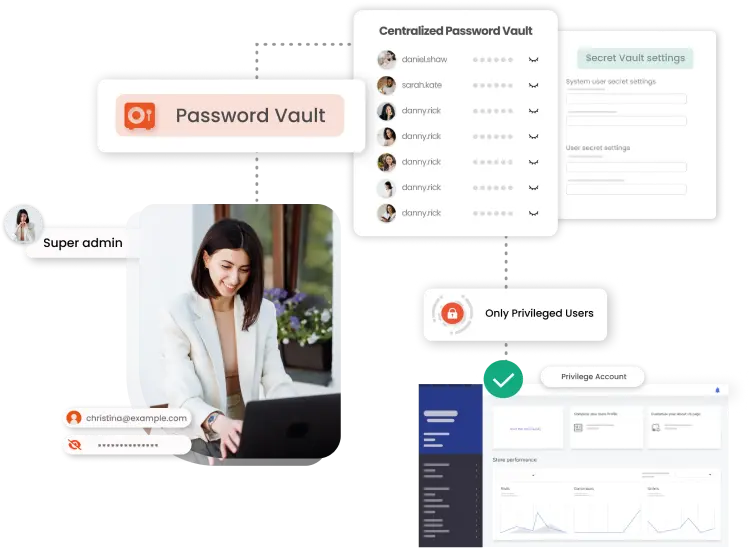
Protect your user accounts centrally with the Password Vault feature of miniOrange's Privileged Access Management solution. Implement strong passwords and MFA, and spin and regularly manage privileged account credentials with industry-standard encryption for secure password management.
- Password Vault identifies and adds privileged accounts to the management system.
- Ensures secure storage of privileged passwords in an encrypted vault.
- Effectively removes credentials embedded in scripts and code.
- Automatically updates passwords periodically.

Monitor and session control
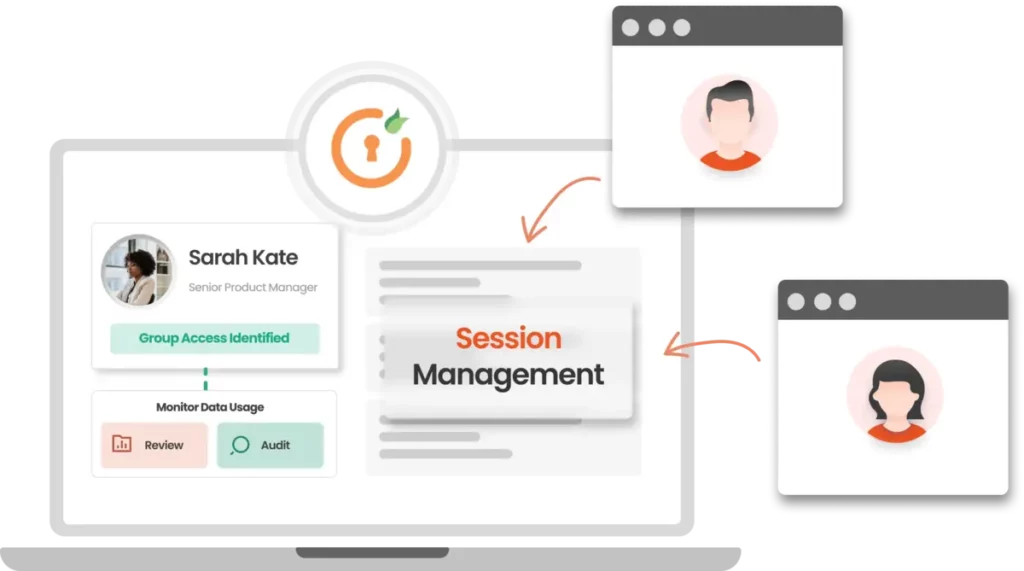
Get real-time visibility with live session streaming for rapid threat response through Session Monitoring and Control.
- Session recording for compliance and investigations.
- Terminate sessions instantly to stop suspicious activity.
- Receive instant alerts for unauthorized behavior.
- Monitor and analyze session activity easily with an intuitive dashboard.
Privilege account and session management (PASM)
Privileged Session Manager is a crucial component in managing secure access to an organization's sensitive IT assets.
- It acts as a gatekeeper, defining the duration of access and the reasons for the administrator's access.
- It facilitates access to essential systems, such as device management interfaces or UNIX server root files.
- Imposes restrictions based on time or functionality in each session.
- It guarantees controlled and monitored privileged access, improving the overall security posture.
Privilege Elevation and Delegation Management (PEDM)
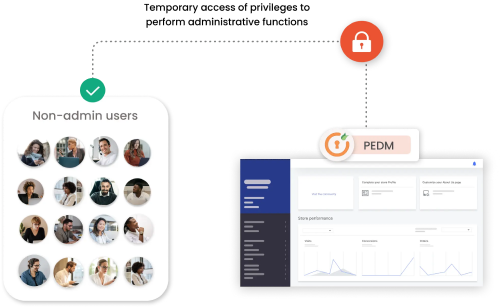
The Privileged Access Management Privilege Elevation and Delegation feature allows you to assign time-limited access to restricted resources to specific users, adapted to their current privilege levels.
- Avoid giving standard users permanent access to confidential resources
- Offers exclusive and time-limited permissions
- Minimizes risks linked to users with excessive privileges.
- It is in line with the principle of least privilege.
- Guarantees greater safety and efficiency.

Just In Time (JIT) privileged access
Just-in-Time (JIT) Privileged Access refers to the dynamic provisioning of access rights to users for a limited duration, precisely when such access is required. It minimizes the security risks associated with permanent privileges.
- Ensures that access to confidential resources is granted as needed.
- JIT access simplifies operations and increases safety.
- Limits the period for possible misuse of elevated privileges.
- It supports a secure, efficient and compatible IT environment.


PAM without agent
The Agentless Privileged Access Management feature offers a hassle-free deployment process, as it eliminates the need to install and manage PAM agents on each endpoint.
- Simplifies the deployment process
- Saves valuable time and resources
- Mitigates risks associated with vulnerabilities or agent compromise
- Ensures a more secure privileged access management environment
Endpoint privilege management
The growing number of endpoints and the increasing complexity of cyber threats are making organizations more vulnerable than ever. Effective Endpoint Privilege Management is essential for protecting sensitive data and preventing unauthorized access. The Endpoint Privilege Management feature of miniOrange's Privileged Access Management solution allows you to:
- Complete security: Windows, Mac e Linux
- Remove local administrator rights
- Mitigating the risk of security breaches
- Apply least privilege
- Implement endpoint security controls
Benefits of privileged access management
Questions Frequent
Why is privileged access management important?
Privileged Access Management (PAM) empowers security squads to identify and respond to malicious user actions resulting from the misuse of privileges. It facilitates immediate risk mitigation. By implementing a PAM strategy, organizations can ensure that team members only have the essential access rights required for their roles. In addition to detecting malicious actions related to misuse of privileges, a PAM system helps an organization to:
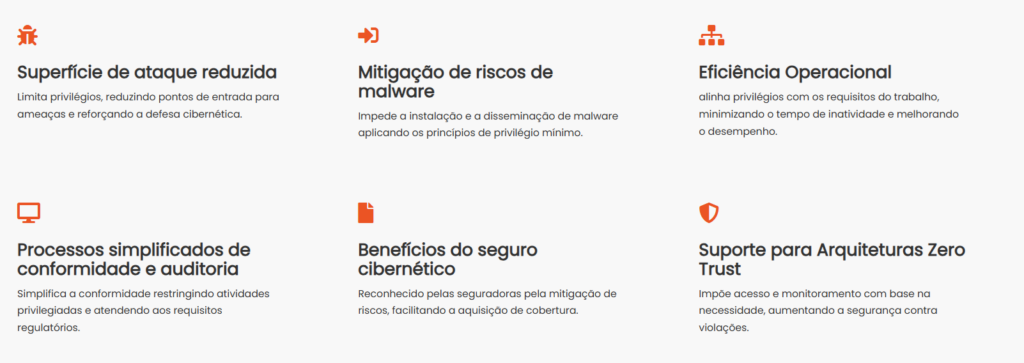
- Eliminates the risk of a possible security risk In the event of a breach, a PAM solution can help minimize its impact on your system.
- Reduces paths for malicious users The main purpose of this system is to: limit privileges for people and application processes, protecting them against internal and external vulnerabilities.
- Prevents the spread of malware threats : Through a Privileged Access Management solution, it is possible to prevent a malware threat. Access to the system can be prevented by removing excessive privileges.
- The PAM solution creates an easy-to-audit environment Establishes a complete approach to security and risk management through detailed activity logs. Allows users to supervise and identify unusual behavior.
- Improves operational efficiency The most effective way of limiting access privileges is by limiting access privileges to only those processes required for tasks. Reduces the likelihood of conflicts between applications or systems and reduces the potential for downtime.
What are the best practices for managing privileged access?
The more comprehensive your strategies and implementations for privilege security, the more effectively you can respond to threats from inside and outside your organization. As well as complying with regulatory requirements. Let's now take a look at some of the main PAM best practices:
- Establish an elaborate access privilege management policy define how privileges are assigned and revoked, make an inventory and apply the best security practices.
- Discover and manage all privileged accounts Identify all types of privileged accounts, including user, service and application accounts, on various platforms and ensure that they are under management.
- Apply least privilege access remove unnecessary privileges, limit access to what is necessary for the tasks and apply just-in-time (JIT) access to minimize possible abuse.
- Remove administrator rights on endpoints Default for standard user privileges, allowing specific elevated privileges for tasks as needed.
- Implement separation of privileges and tasks differentiate account functions and ensure that privileges are specific to the tasks required, minimizing overlap.
- Segment networks and systems create different levels of trust and apply stricter security controls when necessary to contain breaches.
- Apply robust password security centralize credential management, apply strong password policies, change passwords regularly and eliminate password sharing.
- Secure access to infrastructure Apply PAM principles to manage access to the infrastructure, using workstations with privileged access and limiting the scope of access.
- Monitor and audit privileged activities Use privileged session management to record and control sessions, ensuring compliance and detecting suspicious activity.
- Implement context-based dynamic access : adjust access based on real-time risk assessments, applying principles zero confidence to limit exposure.
- Automate workflows for privileged tasks : securely manage automated tasks that require elevated access, ensuring smooth integration into IT environments.
- Use insider threat analysis Monitor the behavior and access of privileged users, alerting you to deviations that represent a risk and making security decisions based on data.
How to implement Privileged Access Management?
- Get total visibility and apply control PAM: ensure that your PAM strategy provides complete transparency over all privileged accounts, human and non-human, allowing you to:
- Identify and eliminate unnecessary standard administrator accounts, strictly applying the principle of least privilege.
- Continuously govern and control privileged access to prevent the escalation of unauthorized privileges, thus protecting your organization's cybersecurity posture.
- Monitor, audit and automate for efficiency and compliance : implement policies to monitor and audit privileged actions, distinguishing legitimate behavior from policy violations.
- Take advantage of automation in your PAM solutions to efficiently manage millions of accounts and privileged assets.
- Reduce manual administrative efforts and improve security and compliance by adapting them to meet your specific regulatory needs.
- Use Privileged Account and Session Management (PASM) centralize password and privileged session management to protect all privileged accounts with a secure password vault and monitor sessions for high security
- Apply Privilege Elevation and Delegation Management (PEDM) Manage granular elevation of privileges on endpoints, servers and infrastructure, including application control and least privilege implementation.
What is the difference between AMI vs PAM vs PIM?
Identity and access management (IAM) comprises a set of rules that identifies and controls Who, When, Where and How user access to resources will be provided. They consist of Single Sign On (SSO) , Multifactor Authentication (MFA) , Password Management and User Lifecycle Management .
The main difference between PAM and IAM is that Privileged Access Management (PAM) involves specific processes and technologies dedicated to protecting privileged accounts. PAM, as a critical subset of Identity and Access Management (IAM), is designed to regulate and monitor the actions of privileged users, who have access levels that exceed those of regular users when they are logged into the system.
When discussing difference between PAM and PIM It is important to note that Privileged Identity Management (PIM) is also a key component. It focuses on managing, monitoring, controlling and protecting privileged users' access rights to critical resources within an organization.
How can companies use privileged access management?
- Companies can use Privileged Access Management to improve their security by controlling, monitoring and managing the access rights of users with elevated privileges. PAM helps reduce the risk of data breaches by ensuring that only authorized users have access to confidential systems and information.
What is a PAM tool?
- A Privileged Access Management (PAM) tool is a cybersecurity solution that helps organizations protect, control, manage and monitor privileged access to critical digital assets. These tools are essential for enforcing security policies, providing authentication and provide detailed log information on all privileged sessions, thus preventing unauthorized access and misuse of privileged credentials.
Why do we need privileged access management?
- Privileged Access Management is necessary to protect organizations from the risks associated with privileged accounts, such as insider threats, external attacks and data breaches. By managing and monitoring privileged access, PAM solutions help ensure that only authorized personnel can access confidential systems and data, which reduces the overall attack surface and increases overall security.
What is a common reason for granting high-privilege access to a user?
- The reason for granting high-privilege access to a user is to allow them to perform specific tasks that require elevated permissions, such as system maintenance, network configuration or managing security settings. High-privilege access is usually granted to IT administrators and other roles that manage and secure the IT infrastructure.
Who should administer the privileged access management tools?
- Privileged Access Management tools must be administered by trusted professionals within an organization. These administrators are responsible for configuring the PAM solution, defining access policies, monitoring privileged user activities and ensuring that the system remains secure against unauthorized access and potential security threats.
What is PAM in cyber security?
- Privileged Access Management (PAM) in cybersecurity refers to the technology for managing control over the elevated privileged access and permissions that users have within an organization's IT environment. It is designed to prevent breaches and insider threats by managing and monitoring privileged accounts and their access rights.
Is Okta in Brazil?
Okta is not a company present in Brazil, but miniOrange, a superior solution with more than 25,000 customers + 6,000 integrations with proactive support in IAM/ CIAM and PAM, has a strategic partnership with WebSIA in Brazil and Latam.