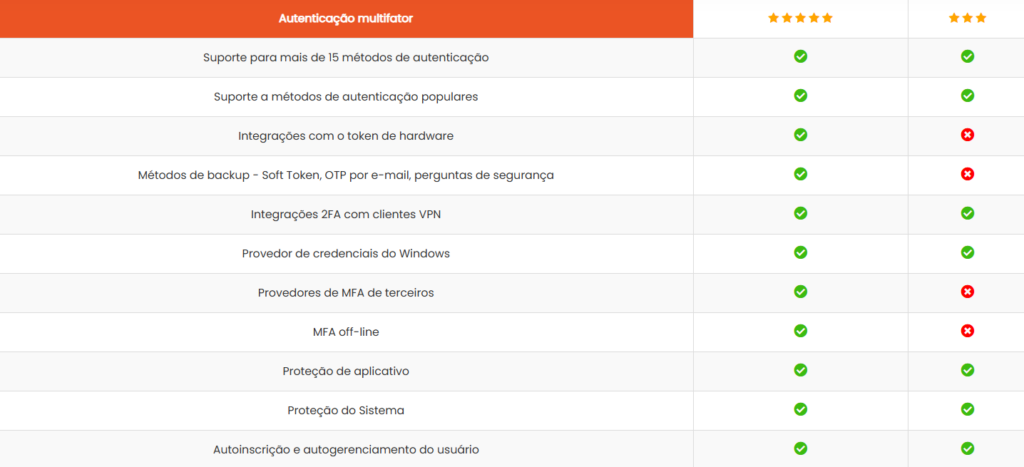
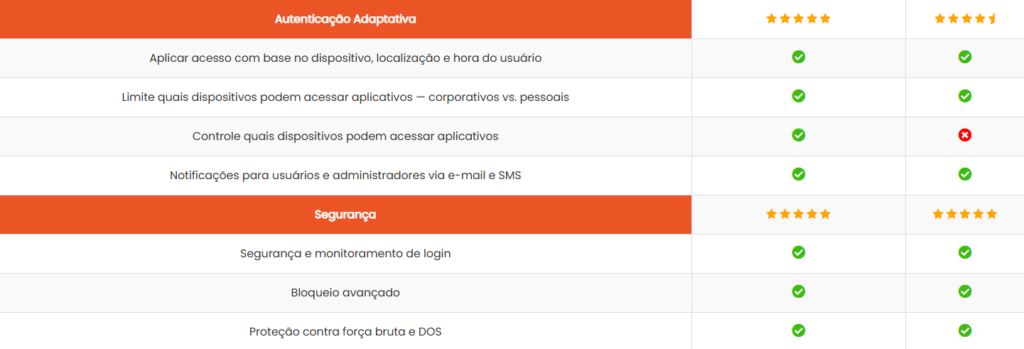
Why should you consider miniOrange for identity security instead of Okta?
1. Multiple Directory Management and Advanced SSO Policies: miniOrange allows unified integration of directories such as Active Directory, Azure AD e Google Workspace. This makes it easier to manage identities and avoids migrating to a new platform. Okta, on the other hand, requires all users to be stored in the system itself, limiting flexibility.
2. Deployment options: miniOrange offers solutions in cloud e on-premisesensuring compliance with security requirements. The solution on-premises keeps data stored internally. On the other hand, Okta works predominantly in the cloud, which may not be ideal for organizations with data restrictions.
3. Specialized technical support: miniOrange stands out for its support 24/7Okta's technical engineers are available for immediate assistance. In contrast, some customers report that Okta's support is less responsive. In addition, Okta's processes rely more on documentation and offer less direct interaction.
4. Legacy integrations: miniOrange provides unique connectors for SSO and MFA in legacy applications such as Oracle EBS and SAP, simplifying integration without the need for complex additional components. Okta, on the other hand, may require more complex configurations to achieve the same functionality.
5. Ease of Implementation and Migration: miniOrange authenticates existing identity sources directly. This eliminates the need for migration and simplifies implementation. In contrast, Okta generally requires the migration of identities, making the process more complex and susceptible to risk.
These advantages show how miniOrange offers flexible and customized solutions. Compared to Okta, it better meets the specific needs of different organizations.